Thursday, March 31, 2016

Wild Grape Vine, Eyed Click Beetle, Sixth Graders


This entry was drawn yesterday during my class with two sixth grade boys.  They are such fun, and both seem eager to draw... except on beautiful sunny day just before spring break!  They were hilariously hyper yesterday, but still I taught them a few important things, such as how to identify our Official State Wildflower, Carolina Jessamine, and how to identify a Tiger Swallowtail butterfly (we saw them everywhere!) and their main host plant, Tulip Poplars.  We also found an Eyed Click Beetle, which look scary because of their huge false eyes. We all held him to feel his CLICK!

After a lot of playing around, we sat at the edge of the woods to draw a wild grape vine and any other little thing we might see nearby.  Rufous-sided Towhees and Cardinals and Crows made appearances while we drew.

Here are a few sketches from the boys.


 Wild Grape Vine


 Close up of DNA of a gnat. Ha!


Wild Grapevine


Daisy helping to carry home one of our sitting rugs. For the record, I didn't realize how completely miserable she was until I looked closely at this photo. Poor old girl. She carried it pretty far (for her). I won't let it happen again. 


Heading back

Sunday, March 13, 2016

Mysteries of Migration


The article above can be found in this month's issue of Wildlife in North Carolina magazine.  Every month the magazine includes a four-page section called "Wild Notebook" which is written for families with children, and for teachers to print and hand out in their classrooms.  I've been writing and illustrating for Wild Notebook for many years, and continue to feel thankful for the opportunity to share with children my love for and fascination with all aspects of our natural world.

The Hummingbird paper sculpture project is by Anne Runyon, one of the most creative and brilliant artists I know! She designs a new project for each article.

Enjoy!

Helen

Friday, March 11, 2016

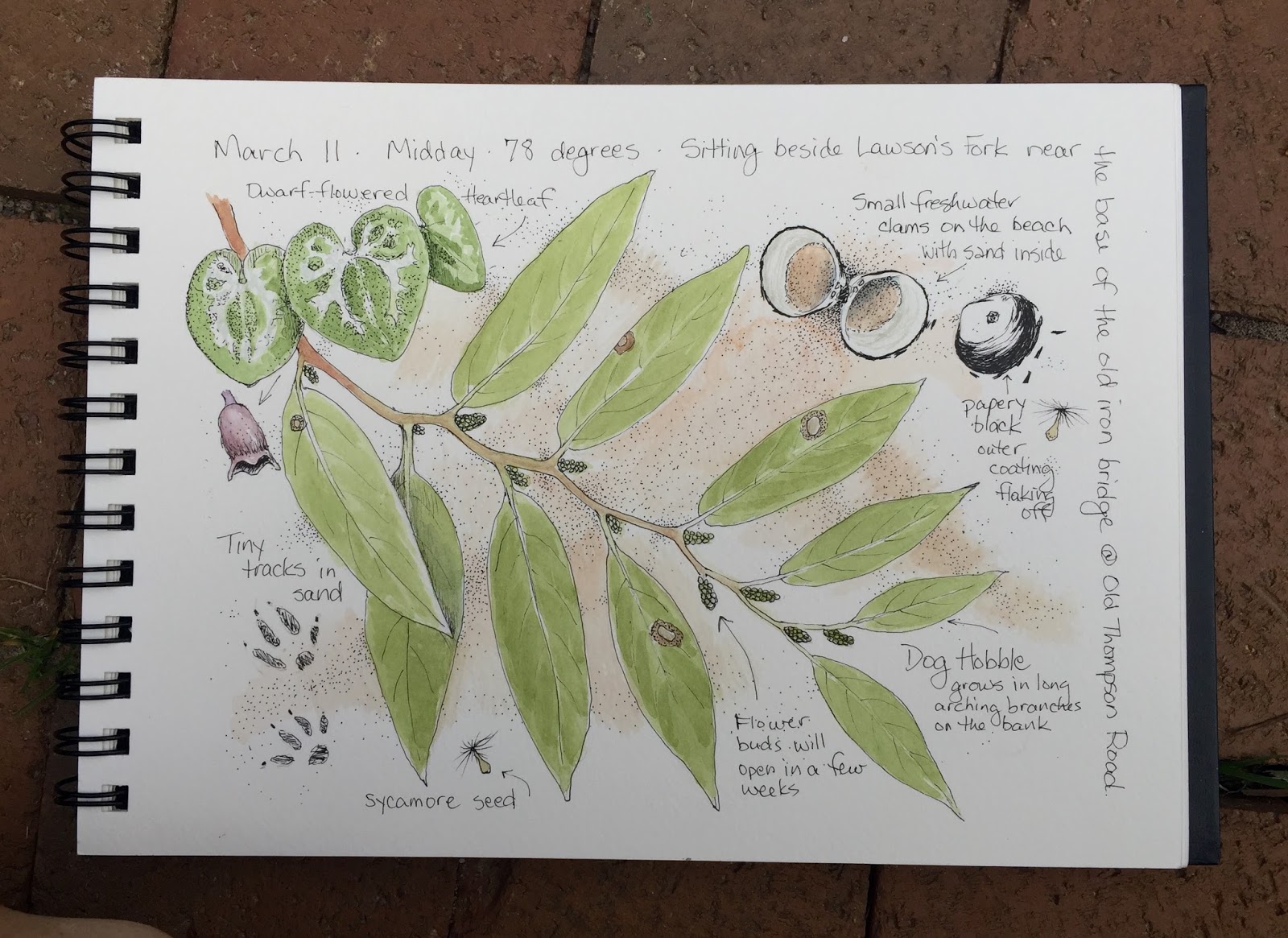
Riverbank: Dog Hobble, Dwarf-Flowered Heartleaf, Asian Clams


The dogs and I spent a couple hours by the river this morning, me drawing, Daisy and Duke playing in the water for a while, then napping. By noon it was 78 degrees, warm for mid-March, and sitting beside a rushing river is a wonderful way to enjoy it.

We wandered around a bit first and found a pile of small clam shells near the water where, a while back, raccoons had eaten a feast.  There were tracks nearby that were new, (the shells were not) but they are not raccoon.  I'll look them up in my tracks field guide.

I discovered a natural chair at a spot where an old wild grapevine rests on the ground. (see photo below) Sand had washed down and filled in behind the vine to make a soft, flat seat, and from there I could see the long arching stems of Dog Hobble (Leucothoe axillaris) as well as the small leaves of the Dwarf-flowered Heartleaf (Hexastylis naniflora), two typical north-facing riverbank species. Daisy found a spot just below where I sat, while Duke climbed and settled above me on the steep bank.  The rushing water kept us all company.

Another thing I'll look up tonight are the cute, tomato-red bugs that were out in force on that sandy bank.  Everywhere I looked I saw one running around.  It occurred to me that I should be careful since the bugs were RED, and supposedly announcing that they are poisonous, or at least would make me itch. But then again, they may just be faking it.  I was not particularly careful, but I never got a bite! Because of this I assume they are harmless... If I'm wrong (and just lucky not to get bitten), I'll update! 

Helen


Bug and Tracks UPDATE: Sunday, March 13

Clover Mites (Bryobia praetiosa) are bright red when young.  Perhaps the ones I saw had just hatched out.  Older ones are reddish brown, and probably difficult to see.  

This is one of several field guides to animal tracks. The tracks I saw were not clear enough to identify, and I can't remember exactly how big they were. I remember thinking they were too big to be a squirrel. I will probably go back later today to see if I see any new ones.


Wednesday, March 9, 2016

Daffodils, Violets & Clematis vine


We are enjoying a taste of Spring weather this week, with temps in the mid-70's yesterday and today, and it looks to be nice all the way until Saturday. Spring surprises are popping out every day. It's time for the ephemerals (wildflowers that bloom before the trees leaf out), and while hiking with my sons Sunday I found both Rue Anemone and Round-lobed Hepatica just beginning to bloom.

I planted the little miniature daffodils (above) in a big green pot a few years ago, along with the clematis. The violets in there are wild and self-sowed all around, in and out of the pot. While drawing I noticed that down near the bottom, the pot has cracked completely around. Ah, well. Nothing to do about that. Instead I closed my eyes to listen to the birds and smell the warming earth.  It was heavenly. A bird fluttered just behind my head, and I assume it was the Tufted Titmouse that had been singing just seconds before.  A female Cardinal chip chip chipped to her mate from the Forsythia, which is just beginning to open. A Question Mark butterfly flittered above the warm gravel in the driveway.  I'm so glad Spring is on its way!


Yesterday's drawing spot


Rue Anemone

Saturday, February 20, 2016

Last Beach Day

Ahhh, well, no drawings today, it being our last day, plus we went out to dinner, which changes the whole afternoon.  Here are some pics from the day, though.  Enjoy.

 man-made oyster shell tower


 tiny sea urchin


 yellow & purple sea whip


 Channeled Whelk


 four-armed starfish


Friday, February 19, 2016

February Fossils


Oooh, it was cold today!  Well, not so much temperature-wise, but the wind chill made it pretty hard to stay on the beach for long.

This journal drawing honors my best fossils from this week.  Each one was found on a different day, each one a thrill.  For the record, I'm serious about my fossils and have five fossil books that help me identify what I find.... so when I say that one is a camel tooth, it's true.  There is a particular way a camel tooth is different from horse's tooth - I won't go into details. ;-)

These fossils are all Pleistocene material, which means they are between 10 thousand to 1.8 million years old.  That long ago South Carolina had many different animals wandering around - Mastadon, Mammoth, Giant Ground Sloths, Camels, Saber Tooth Cats, Dire Wolves, Capybara, Glyptodonts, and more.  We know this from finding their fossilized bones, bones which have turned to stone. This is how you can tell it's not new material.  In fact, I did find a huge femur-looking bone at low tide, and my heart skipped a beat!  Wow!  But when I picked it up it was very light weight, and when I tapped it with an oyster shell, the sound was not the high, ringing (rock) evidence of a fossil... it was a soft, unimpressive thud.  I was sad, but it is what it is.  This is to say, the fossils above are good, though, and passed all the tests.

We have one more day, and windy or not, I'll be out fossil hunting.  Maybe I'll have something exciting to share tomorrow.

Helen


A minute after taking this, I found the claw!

Thursday, February 18, 2016

Sea Whip & Atlantic Winged Oysters


Strolling along the cold, windy beach today I found this yellow Sea Whip washed ashore.  I've drawn sea whip before in my journal, but this time it's a little different because this one supports two Atlantic Winged Oysters that had attached themselves to the branch with thin brown wire-like things, apparently made by the animal.   

Around here, sea whip can be found growing in the deep water creeks that run through the marsh behind the island.  I've seen them many times at low tide, swaying in the currents below my kayak.  All the colors grow together, and from above it looks like a magical world.  I know there are crabs that live on the sea whip, but didn't know that these little winged oyster shells (full size is 2.5") use the branches, as well.

As mentioned on the page above, sea whip comes in many colors, including purple, orange, white, red, and yellow.  A fun tidbit: the tiny crabs that live on the sea whip eat the little coral animals in the tiny holes of the whip, so each crab turns the color of the whip it's living on.  


My ride to heaven.


Wednesday, February 17, 2016

Winter Beach: Operculum, Sand Collar & Fossil Turtle Shell


When I was younger the beach was all about sun, heat, baby oil, suntan, bikinis.  Summer couldn't come soon enough. Now, though, it's a winter beach that calls to me.  Cold and wild, empty except for birds, I love a winter beach, and this week I am thrilled to be staying on my favorite island,
Edisto. The goodies in my post above were things I picked up as I strolled along.

The operculum is basically a trap-door used by all univalves when they pull themselves into their shell for protection.  It feels almost like thin wood, and a fresh one looks like it could have been stained and varnished. The one above is large, 4 1/2" long, so it came from a really big shell. I mentioned Horse Conchs, but it could also be from Lightning Whelk, Knobbed Whelk, or Channeled Whelk, all of which are abundant on this island.

The sand collar is the egg case of a Shark Eye.  They are made of sand and mucus and encircle the mother shell.  As she creates it she embeds her eggs in the sand.  As soon as they dry, the collars return to being sand, so if you find one, don't plan on saving it.

More to come!

Helen


Friday, February 12, 2016

Partridgeberry


   Winter in the upstate of South Carolina is a time of contrasts.  In our woods lie great expanses of gray and naked deciduous forests which show off the rolling, leaf-littered terrain. As a native Floridian I truly love the naked trees. They are an amazing sight, even after living at Middlewood for 26 years.

There are also thick evergreen pines that sway and groan in the cold winter blasts. These are mostly loblolly, Virginia, and shortleaf pines.  They line our sunny pipelines. Tucked under the pines you will find the lovely Partridgeberry (Mitchella repens), small evergreen vines sporting vivid red berries in the winter.  I drew the one above on a cold, sunny day in January.

Saturday, November 8, 2014

Sassafras Leaves, Carolina Locust


Another beautiful fall day at Middlewood!  Daisy, Dukie and I headed out around noon to enjoy the bright colors and cool breeze.  It was best kind of hiking weather. On the pipeline, I can (and do) easily switch from hiking on the shady side (cold) to the sunny side (hot, if there is no breeze). I wove back and forth today.  After we crossed Meetinghouse Creek (cold) we headed up the other side and walked to the sunny side of the far hill to settle down, me to draw, dogs to nap. After about ten minutes, Daisy and Duke moved from the sun to the shade.  Later, Duke wandered off to explore in the woods and Daisy came to sit in front of me to make sure I was safe.

I put my face into the sun and enjoyed the toasty silence with occasional rustling oak leaves and Crows cawing in the distance.  Opening my eyes I noticed in the distance rippling heat waves rising from the warm, sunny side of the pipeline. Suddenly, a loud BZZZZT! broke the silence as a Carolina Locust sprang from the grass beside me, flew about 30 feet, and landed back in the grass.  You always know a Carolina Locust by his black and yellow rear wings, which are only seen when they fly.  Otherwise, they are just average looking grasshoppers.  This guy flew his short "hops" around me for the whole hour I sat drawing.  BZZZZZT!

Sassafras leaves come in various shapes, all on the same tree. Here are three examples, but the possibilities are endless.  These leaves are past the color stage, but aren't the shapes beautiful?

By the time I'd finished drawing, I had taken off my fleece jacket, put my hair in a pony tail, but still felt hot, so we trekked home on the cool, shady side of the pipeline.  On the windy hilltop I felt cool and put the jacket back on.

Here are some photos of our trees, and my sweet guard collie.


Nature Journaling Workshop

A day-long workshop at Heathwood Hall with 54 fifth graders!  Everyone had so much fun learning how to slow down and pay attention to nature's details.  At the end of the day I sat and talked to some of the girls waiting for their mom's to pick them up.  When they asked if they could write me a note in the back of one of my journals, I was happy to let them.  What a wonderful read later that night.


Wednesday, November 6, 2013

Sassafras, Maple, and Oak Leaves


I couldn't let the fall leaves pass without painting a few, so we headed out at midday for a hike and a little journaling time.  Daisy and Dukie did the usual leaping and prancing and fake fighting, and Daisy did her thing of pulling at my shoe laces as I walk... yes, it's always a little difficult getting going!  

Our section of woods is at its peak right now, with hickories, maples, sourwoods, and dogwoods full of rich color.  On the pipeline, though, many of the trees have been stripped bare.  It can be like a wind tunnel out there.  On a breezy day, when you step out of the woods it feels more like the beach than the piedmont of SC.  

As we hiked no human sounds could be heard - no planes, no lawn mowers, no leaf blowers, no traffic - so I was able to hear the soft, high-pitched cheep of  Golden-crowned Kinglets. I found them in binoculars, one male and two females, busy in a dogwood tree.  The male's lovely golden crown was bright and clear. The females look the same, but without the crown, and could be mistaken for other birds, so it's good to see the male with them. It makes identification much easier.  The dogs weren't impressed, so we headed on so they could run, run, fast, fast!  

I hiked (the dogs ran!) downhill toward the creek, but didn't make it all the way to the water.  Instead, I picked up sassafras and maple leaves and found a sitting-spot at the top of the steep drop-off to Meetinghouse Creek, on the upper edge of the sloping field.  By this time Daisy and Duke were tired enough to take naps, so they settled next to me for a snooze.  

Two leaf sketches later I got up to pick a few leaves off of a baby oak tree nearby. They hadn't completely turned, and I thought the color was nice.  But, when I came back to my journal I found a large Wolf Spider sitting on the page!  I'm better about spiders than I used to be, but I just couldn't bring myself to even try to draw him as he sat on my journal, so I whipped out my trusty iphone and snapped a photo.  

By the end of our journaling time the clouds were breaking up, revealing blue patches, and lots of sunshine.  I packed up my bag and headed into the afternoon sun, marveling at the glowing leaves in the woods.


The view from where I journaled.


2 o'clock sun filtering through bright leaves as we head home.


Come on, Mom!